Begin doing …

I just saw a quote from Walt Disney on a friend’s Facebook page: The way to get started is to quit talking and begin doing.

So much wisdom is so simple.  Simple, but not easy.  My last post here was over 2 months ago!  That sounds so much longer than it seems to me; so much has happened in those 2 months, that chunk of past time is like a blur.  The “doing” part of my life has had very little to “do” with writing, and more to do with being a parent helping a daughter prepare for college.  Her departure is now just a little over a week away.

Not surprisingly, my focus has begun to shift back to writing, to the “plan” for achieving “the goals” I have set for myself.  Certainly, step 1 is to “begin doing.”

To that end, I am considering launching a new site, and it’s an endeavor that has been over ten years in the making.  Let me explain how a new site might help me (and you) begin doing …

I happen to live in an area that is rife with writers.  These writers are not only talented, but are generous with their time, their insights, and their knowledge.  As one of these talented writers once said to me, “None of us do this work alone.”  When I first realized what a wealth of talent and resources existed around me, I began to explore the idea of what I labeled a “Writers’ Energy Exchange.”

In my mind’s eye, it was a physical location where writers could meet informally to work and to assist one another.  Most of us have trusted groups to which we belong, and to whom we can take drafts of poems or whatever we are writing and get some good feedback.  My two poetry groups have been essential for me in my work.  However, I have always thought it would be great to have that kind of feedback on a more spontaneous basis.  “Workshopping” someone else’s stuff is such a two-way street:  when I am given the opportunity to review someone else’s work, even in draft form, invariably I am inspired to work harder and better.
Continue reading “Begin doing …”

April 29, 2010

The last of today’s devices from Packard’s The Poet’s Dictionary:  A Handbook of Prosody and Poetic Devices

Tone: The accumulated effect of style, coloration, and texture. Like atmosphere in a short story or like mood in symphonic music, tone in poetry is the result of particular choices which affect the reader’s overall feeling toward a poem.

One of those choices is “context.” If a poem is part of a collection of poems, the poems often work together to set a tone.

A few years ago, I started working on a group of poems based on the concept of self-portraiture.  Each poem was titled “Self Portrait: [here I would name the speaker of the poem].  It was a fun exercise.  I wrote what I thought were credible (if not true) assessments of myself through that person’s eyes.  I tried to pick people who know me well, and also people who only know me in a certain context (for example, “The Doctor”).

I am going to share with you one of these self-portrait poems because, by itself, its tone is entirely left up to the reader. Where I placed it in the collection, however, would set the tone for the reader; do you agree? Thanks for reading! Continue reading “April 29, 2010”

To Commemorate the “Lost Day” of April 25

The “S” of today’s devices from Packard’s The Poet’s Dictionary:  A Handbook of Prosody and Poetic Devices is

Sonnet:  A fourteen-line poem usually with octet/sestet separation of eight- and six-line formations, usually with a RHYME scheme in either Shakespearean or Petrarchean sequence.

I break from the norm here and, rather than share an original poem, share something from the god of sonnet-writing, William Shakespeare. Continue reading “To Commemorate the “Lost Day” of April 25″

To Commemorate the “Lost Day” of April 18th

The first of today’s poetic devices from Packard’s The Poet’s Dictionary: A Handbook of Prosody and Poetic Devices is

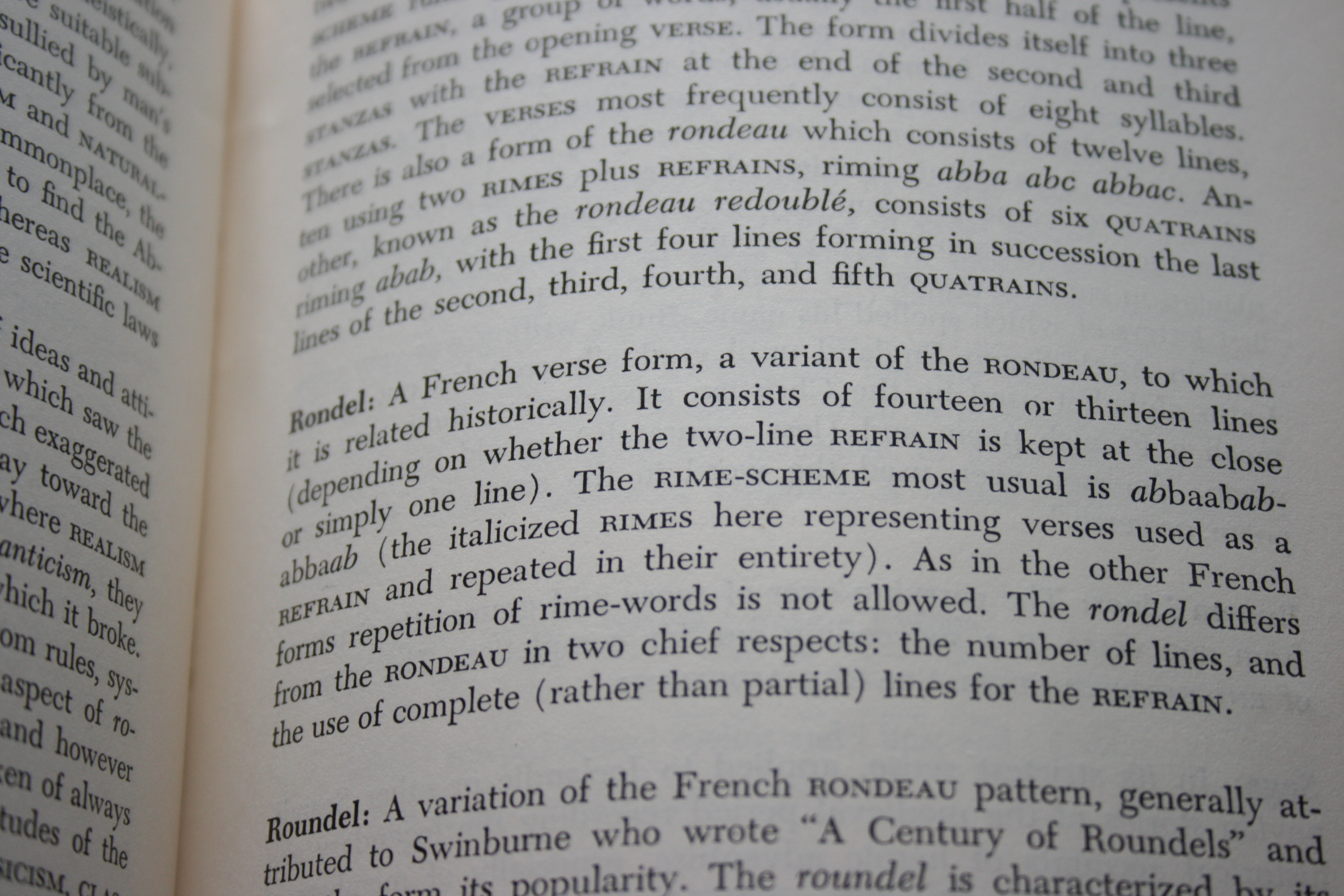
Rondel:  A simple song, usually in strict stanzaic form (see STANZA), using REFRAIN, RHYME and METER.

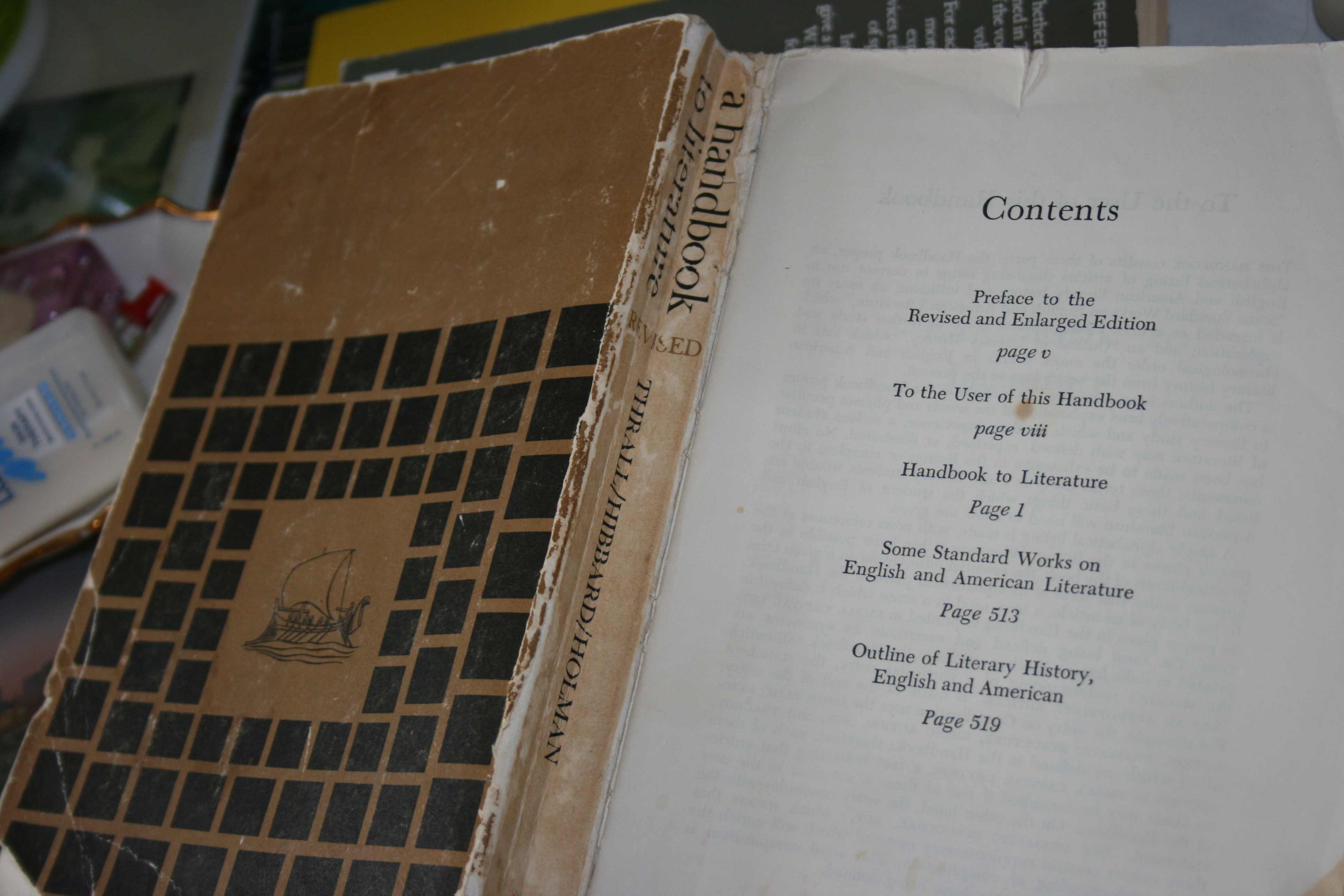
Unfortunately, and, some might argue, unforgivably, Packard does not describe the stanzaic form (or rhyme scheme or meter) in any detail.  I, therefore, had to call in the big guns of Thrall, Hibbard and Holman and consult with my centuries-old A Handbook to Literature (see photo) (I really do have to get the updated version – it’s an essential tool).

Here is the only rondel I have ever written.  Thanks for reading! Continue reading “To Commemorate the “Lost Day” of April 18th”

To Commemorate the “Lost Day” of April 17th

The next device from William Packard’s The Poet’s Dictionary:  A Handbook of Prosody and Poetic Devices:

Prose Poetry:  Poetry having a high incidence of sight and sound and voice devices, but with no formal line arrangements; prose poems resemble loose paragraphs and are sometimes called vignettes.

So many, many, many poets do prose poetry well.  I am not one of them.  Still, this is what I signed on for, so we shall suffer together, dear readers.

I share a prose poem that has found its way in and out of a full length manuscript of mine over the last couple of years.  Thanks for reading! Continue reading “To Commemorate the “Lost Day” of April 17th”